# RP2040-Decoder
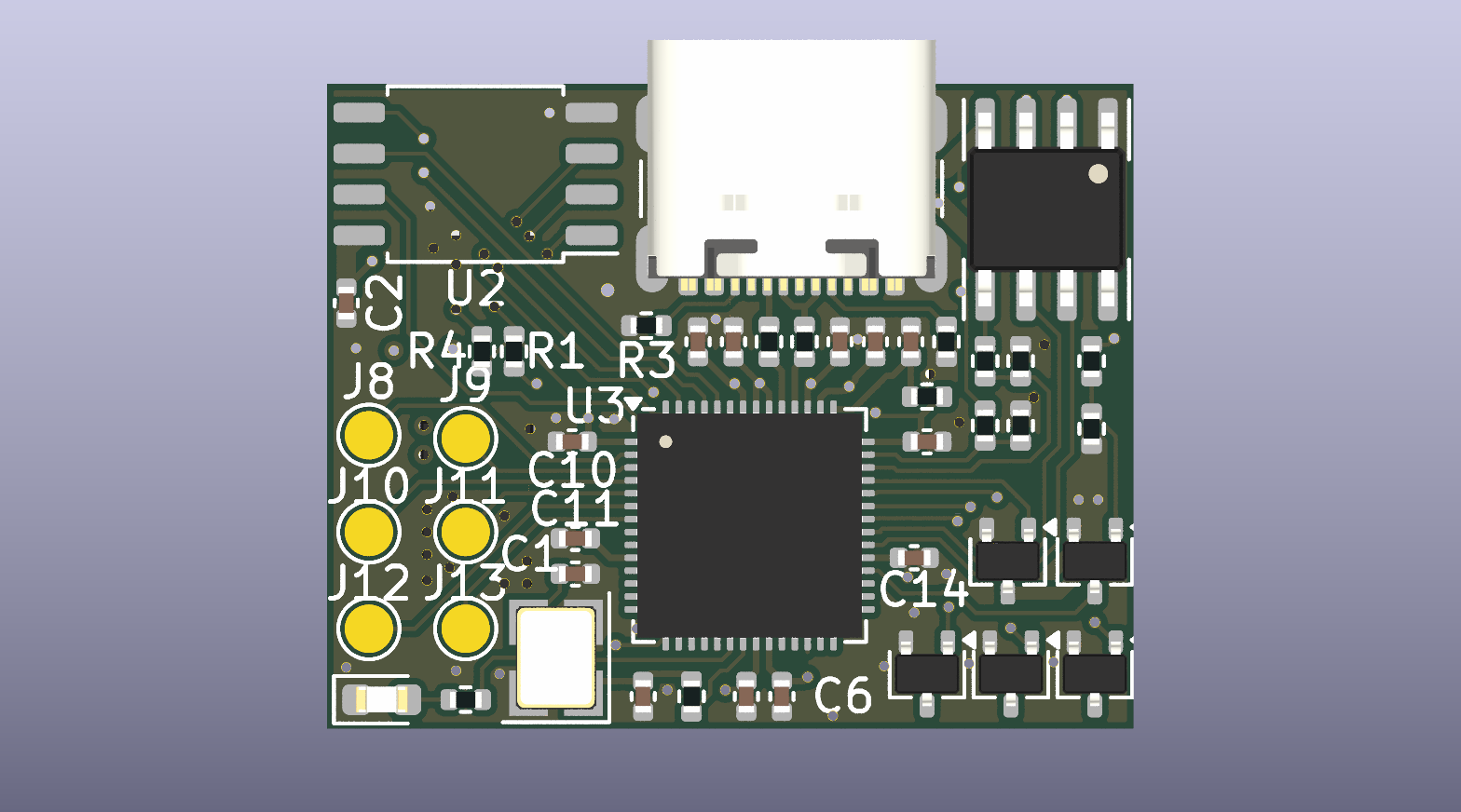
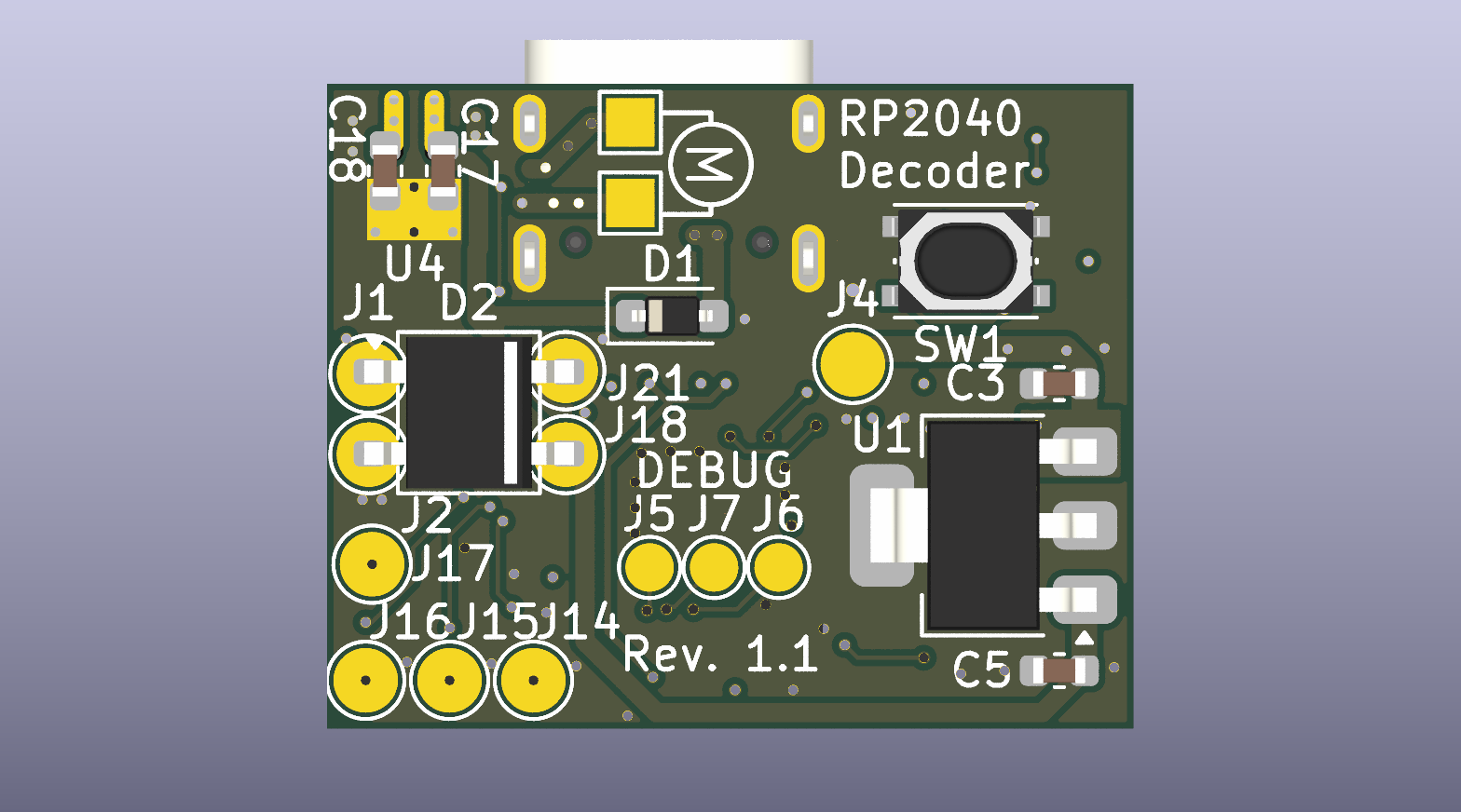
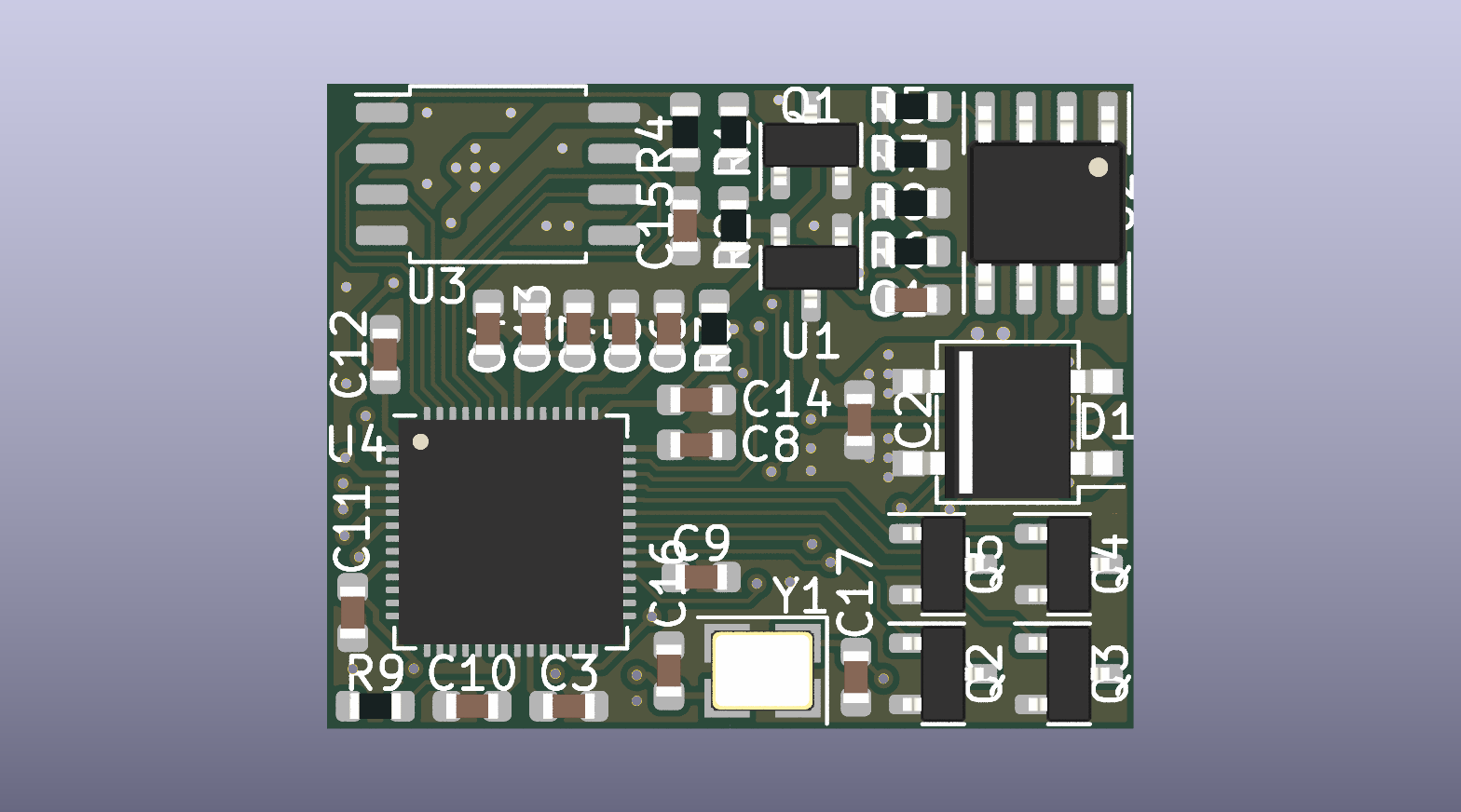
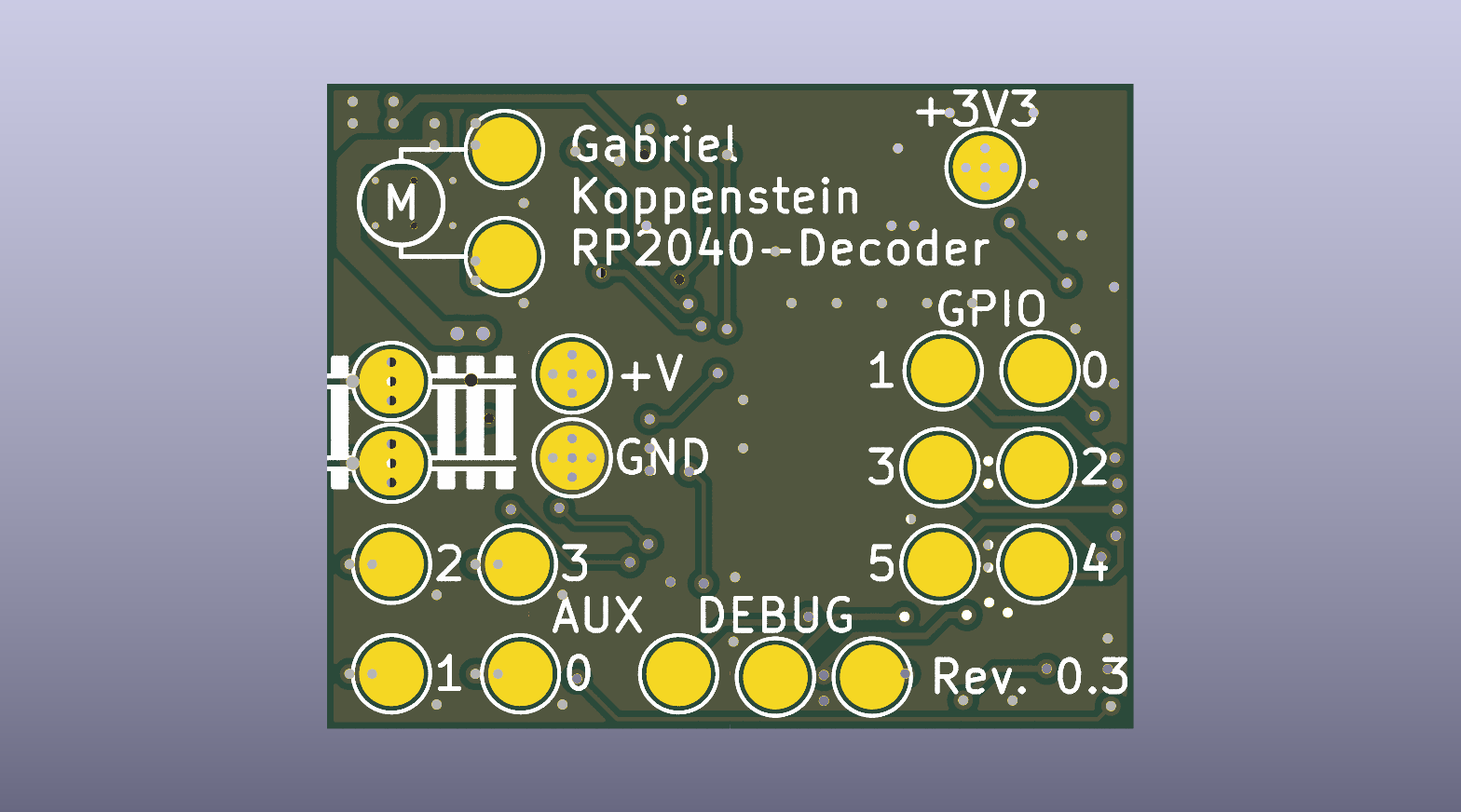
Designed to be a low-cost, open-source alternative to commercial DCC decoders, it utilizes the Raspberry Pi RP2040 dual-core microcontroller. The decoder features DCC protocol decoding and command interpretation alongside motor control in a compact 25x20 mm form factor.
## Key Features
* **DCC Signal Decoding**: Interrupt-based edge detection with full packet/protocol decoding.
* **Motor Control**: 128 speed steps with configurable acceleration/deceleration ramping and v_min/v_mid/v_max; closed-loop control for consistent motor speed under varying load conditions.
* **Flexible I/O**: 4x transistor-switched outputs and 6x additional GPIOs; all of them PWM capable.
* **CV Configuration**: Function mapping and programming track support.
* **Standards Compliance**: Implements the most important NMRA (S-9.1, S-9.2.x) and RCN (210, 212, 216) DCC standards.
* **Compact Form Factor**: 25x20 mm board size.
* **Integrated Documentation**: Comprehensive [GitHub Pages documentation](https://gab-k.github.io/RP2040-Decoder/) covering hardware theory and software implementation.
## Architecture Overview
The system uses each of the two ARM Cortex-M0+ cores for separate tasks:
* **Core 0: Signal Processing & Management**
* DCC edge detection and packet decoding.
* Configuration Variable (CV) management using persistent flash storage.
* Service Mode (Programming Track) logic and acknowledgment pulse generation.
* **Core 1: Motion Control**
* **PID Controller**: A discrete-time PID motor controller implementation utilizing based on a bilinear transform formula.
* **Back-EMF Feedback**: ADC sampling during PWM-off cycles.
* **Adaptive Control**: Gain scheduling for $K_P$ and a startup controller (feed-forward) to overcome static friction.
## Hardware Revisions
### USB Version
Optimized for ease of use; supports UF2 drag-and-drop flashing and serial logging.
### Legacy Version
Revision without USB, one sided assembly, flashed via SWD.
## Getting Started
To get started, you will first need the hardware. The different options for acquiring a board are outlined [here](https://gab-k.github.io/RP2040-Decoder/sphinx/html/gs/getting_started.html#where-to-get-the-board).
For the software, you have a few options: you can either [build it from source](https://gab-k.github.io/RP2040-Decoder/sphinx/html/gs/getting_started.html#building-the-software) or use the ready-to-flash [binaries built by the CI pipeline](https://github.com/gab-k/RP2040-Decoder/releases) on each release. [Flashing the firmware](https://gab-k.github.io/RP2040-Decoder/sphinx/html/gs/getting_started.html#flashing-the-software) can be done via SWD or, if you are using the USB hardware version, simply by dragging and dropping the file using your regular file explorer.
## License
* **Software**: MIT License
* **Hardware**: CERN Open Hardware Licence Version 2 - Permissive